This post may contain affiliate links. Please see my affiliate disclosure for more details.
Why is your blog called “Salt & Lavender”?
My love of salt was inherited from my mom, and salt & pepper was taken… so salt & lavender it is. 😉 When thinking of potential blog names back in 2015, I knew I wanted “salt” as part of the name, and the second word came to me later. There were many ideas tossed around! I am as passionate about flowers as cooking, and lavender works double duty as a culinary ingredient (it’s a component of herbs de Provence, for example). I liked the relaxing images it conjures up when you think about lavender fields.
Do you have calorie counts/nutritional information for this recipe?
I now include nutritional information on select recipes. Nutritional information is provided as a courtesy only and should be construed as an estimate rather than a guarantee. Ingredients can vary and Salt & Lavender makes no guarantees to the accuracy of this information. If a recipe does not contain nutritional info, I am either working on it (I’m going back and doing some older recipes when I have time), or I don’t plan on providing it for various reasons.
I didn’t like this recipe/it didn’t have enough flavor/why didn’t it work/etc.?
Many things can go wrong with cooking, and I’m happy to help you troubleshoot. Please leave a comment on the post – I will most likely see it faster, and others may have the same question. The more details I know, the faster I can hopefully help you figure out what went wrong.
I find that one of the biggest reasons people have an issue with the flavor of a savory recipe (assuming directions were followed) is because they didn’t add enough salt. In general, many people underestimate how much salt a recipe needs, and then they assume something is wrong with the recipe. Why do restaurant meals taste so good? They use enough salt.
Can I substitute X, Y, Z ingredient?
All recipes have been tested as written. I will sometimes include suggestions for substitutions or caution against particular substitutions in the recipe notes of the blog post. With that said, if you’re wondering about altering a recipe prior to making it, run it by me first, and I will see if I can point you in the right direction. Keep in mind that without testing I can’t give a totally accurate answer, especially if it’s not a simple adaptation.
How do I print a recipe?
The print button is located near the top of every recipe card (above the ingredients list).
Can I subscribe to your blog?
You bet! Sign up here or fill in one of the forms that come up as you’re reading a blog post. My email newsletters are free.
Do you have a cookbook?
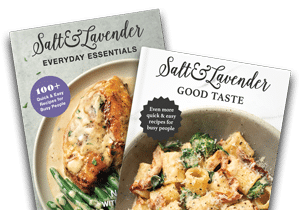
Yes! Our two hardcover cookbooks, Salt & Lavender: Everyday Essentials and Salt & Lavender: Good Taste can be ordered here.
How did you get into food blogging?
I used to read food blogs for fun, and I always wanted to start my own business, so eventually the idea of starting my own food blog came to me! Once I got past my fear of food photography, I started my blog in 2015. Check out my first blog post.
Can I use your recipe in a roundup?
You may use one photo if you link back to the recipe on my site. No need to ask me for permission. 🙂
Can I use your recipe/photos?
Please do not reprint any of my recipes without my express permission. All written content — including the ingredients list and quantities, recipe instructions, and accompanying write-up — cannot be reproduced verbatim. All food/recipe photos are mine and cannot be used without prior written permission. One exception – if you’re doing a roundup-type post you may use one of my photos as long as you’re directly linking back to the recipe on my site and not reprinting the recipe itself.
Do you accept guest posts?
No. It’s important to me that it’s my voice and my photos so the blog has a consistent look/feel.
Photography/Blogging Questions:
What kind of camera and lens do you use?
Since January 2017 I’ve been using a Nikon D7200 with a 35mm f/1.8G lens.
Do you use natural or artificial light in your photos?
When I first started the blog back in 2015, I used natural light. From January 2016 to mid-2017, I dabbled in artificial light. I was new to photography in general, trying to find my style, and I really had no clue what I was doing. I used a video light (an LED continuous light) and a large diffuser, but it never really produced the results I hoped for, so I switched back to natural light. From mid-2017 to May 2020, I primarily used natural light, and my photos gradually improved as I learned more about light, photography in general, and editing my photos (I’ve always used Lightroom). I figured out that bright, cloudy days were ideal for taking photos with my north-facing windows, and so I scheduled my photoshoots around those days as much as possible. This wasn’t easy when I worked an office job full-time because you can’t exactly count on a weekend to be cloudy!
I still felt limited by chasing the sun as a full-time blogger, so in May 2020 I started to experiment with flash photography (this is what many professional photographers, including restaurant photographers, use). It allows you to completely control the light any time of day. I enrolled in Joanie Simon’s Artificial Academy course, and it’s been a total game-changer for me. I use a large softbox (120 cm/47.2″) similar to this one (mine has a bowens mount), a Nikon SB-700 AF Speedlight, and a Godox wireless flash trigger/receiver set. I highly recommend signing up for the flash photography course because it is a learning curve – especially if you’re trying to figure it all out on your own.
Where are your backdrops from?
The marble background that I use in most of my photos nowadays is a marble baking slab from Crate & Barrel. I also own many backdrops from Erickson Surfaces. I highly recommend them! I also have a double-sided backdrop from Food I Fancy that I really like. If you’re wondering where I got a specific backdrop, don’t hesitate to ask!
Do you have any tips on how to become a successful blogger?
I have a few posts that may help you out here. My #1 tip is to post consistently because the only way to learn what works and improve your content is to try, try, and try again.